
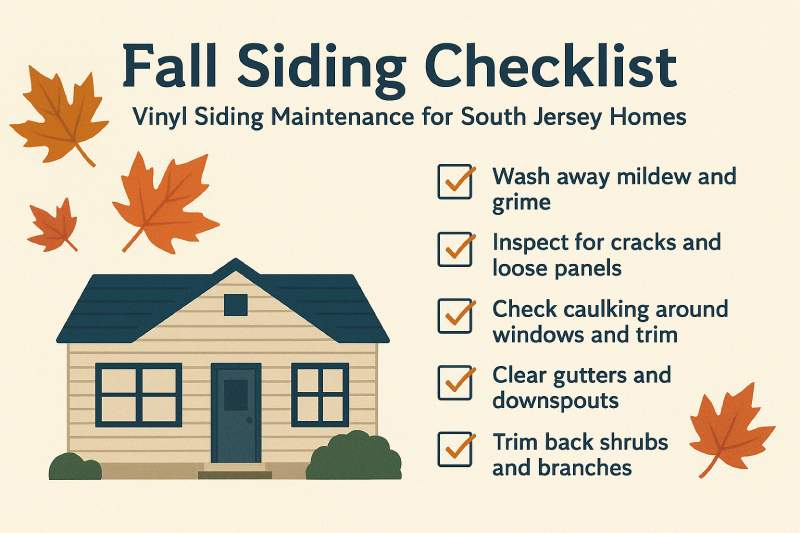
Fall is the natural time to check your siding. You're already outside putting away furniture and clearing gutters, and the wall behind the patio chairs is suddenly in view. If it looks dull and grimy, don't reach for a scrub brush or pressure washer. Look first, clean gently second, and learn to recognize the problems cleaning can't solve.
This checklist covers a walk-around, gentle cleaning, the water and movement details that matter, and how to sort routine care from repair and replacement.
Vinyl Siding Inspection: Walk the House Before You Grab the Hose
Cleaning a cracked or loose panel can make it worse, and soapy water hides details you'd spot on a dry wall. Inspect first, handle the manageable items yourself, and bring in qualified help for anything serious. A ground-level walk-around won't reveal every hidden issue, but it catches most of what a homeowner can reasonably spot.
What to look for on every wall
- Cracked, chipped, or punctured panels, especially near grills, mower paths, and where kids play ball
- Loose, sagging, or unlatched panels, or pieces that have slipped out of position
- Waves or warping across a wall, as opposed to a single dented spot
- Fading or chalky residue, which is often normal weathering (more below)
Sheltered spots your rinse misses
Give under eaves, porch enclosures, shrub-covered walls, and shaded north-facing walls their own pass. CertainTeed's maintenance instructions name rain-protected spots like these as places where mildew can form, because rain never rinses them. If you've noticed mildew on vinyl siding, odds are it started in one of these corners.
Photograph each wall every fall
Shoot the same views each year: every wall's corners, the area under the deck, and the wall below any roofline. Next year you'll have a record to compare against instead of wondering whether that wave or gap "was always there."
If you find cracking across many panels or widespread warping, skip the cleaning and get a professional opinion first. CertainTeed's guidance on when to call a contractor draws the same line.
How to Clean Vinyl Siding Without Damaging It
CertainTeed recommends cleaning vinyl siding at least once a year.
That's from the manufacturer's own cleaning instructions. Treat it as an appearance-care baseline, not a guarantee against installation problems or hidden moisture issues.
The whole kit
Cleaning vinyl siding takes no specialty gear:
- A garden hose
- A soft-bristle brush or soft cloth, ideally on a long handle
- A cleaner approved for your siding (check the manufacturer's guidance and the label)
- A bucket
Wash bottom-up, spray level or down
Washing direction and spray direction are different things. CertainTeed's instructions call for washing from the bottom up to minimize streaking, then rinsing thoroughly. Never aim pressurized water upward under the panel laps, which drives water behind the siding instead of off it.
Pressure washing vinyl siding: check your product, not a blog
You won't find a "safe PSI" number here, on purpose. The Polymeric Exterior Products Association notes that pressure-washing restrictions vary by manufacturer. If you don't know the brand, a garden hose and a soft brush is the safe default.
Stronger isn't better
Georgia-Pacific's care and maintenance guidance warns against excessive scrubbing, abrasive cleaners, and strong solvents. Test the cleaner on a small, out-of-sight area and check the result once it dries. The same goes for removing mildew from vinyl siding: start mild and stay mild.
A chalky film on older siding is usually normal weathering, not proof that you ruined anything by skipping a few washes.
Don't Caulk the Gaps: How Water and Panel Movement Work
A clean wall isn't automatically a healthy wall.
Siding sheds water; house wrap and flashing handle the rest
Vinyl siding sheds most of the rain but is not a watertight shell. Behind it, the water-resistive barrier (house wrap) and flashing handle whatever gets past. The Vinyl Siding Institute installation manual describes these roles: siding as the cladding, house wrap as the barrier, flashing directing water out. That's why some openings are intentional.
Panels are built to shift
A 12-foot-6-inch vinyl panel can expand and contract half an inch or more with normal yearly temperature changes.
That figure comes from the VSI installation manual, and it explains how vinyl siding is meant to be installed and cared for.
Leave these alone
- Panel overlaps and receiving channels: industry installation guidance says not to caulk these
- Weep and drainage openings: they're exits for water, not defects to plug
- Panels that "move" slightly: don't immobilize them with extra nails or screws
CertainTeed's installation guidance requires expansion space and freely moving panels. For what that looks like on a proper job, see the best way to install vinyl siding.
A hypothetical: A homeowner hears a panel tick and shift on cold mornings and drives in a few tight screws to "fix" it. By next summer the panel has buckled, because it had nowhere to expand. Cleaning and observation are DIY jobs. Fastening and resetting panels takes installation know-how.
Gutters and roof-to-wall spots
You're likely cleaning gutters this fall anyway, so fold siding into the same pass. Check that downspouts discharge away from the wall, look for overflow streaks, and inspect from the ground where a lower roof meets a sidewall.
Runoff is a bigger deal than most people assume. Pacific Northwest National Laboratory notes that a few inches of rain can send thousands of gallons of runoff off a typical roof. Volumes vary by house, but that scale shows why water handling belongs in a siding checklist.
The stain that returns after every wash
A streak below a roof-to-wall corner that comes back every year won't be fixed by stronger chemicals. The location is the clue.
Missing or failed flashing at roof-to-wall intersections can send water down the wall, and PNNL's guide to spotting missing roof-to-wall flashing shows what to look for. A recurring stain is worth investigating, though it isn't proof of a specific problem. For more, read why siding leaks often start at the roofline.
From the field: After decades of pulling old siding off South Jersey homes, Joe Bibbo pays the most attention to stains under rooflines and corners. Dirt spreads evenly. Water leaves a path.
Cracked or Warped Vinyl Siding: Clean, Repair, or Replace?
Washing the windshield doesn't fix the crack. Sort this year's findings into three groups:
- Cosmetic: dirt, mildew, and chalking that come off with gentle cleaning
- Localized: a cracked panel or loose piece in one area, usually a vinyl siding repair
- Widespread: cracking across many panels, warping across walls, or signs of moisture problems behind the siding
The last group calls for a professional evaluation, not a stronger cleaner. CertainTeed's contractor guidance separates DIY care from contractor-level problems the same way.
Two walls, two findings (illustrative)
| Wall A | Wall B | |
| What you see | Gray film, green tint on shaded side | Cracks across numerous panels, visible waves |
| After a test cleaning | Comes clean | Still cracked and warped |
| Next step | Annual gentle cleaning | Professional assessment |
Aging is real, but neglected doesn't mean finished
NIST published research in September 2024 on weathering and formulation properties of vinyl siding. Environmental exposure can contribute to degradation and cracking over time. Cleaning keeps siding looking its best but doesn't reverse material aging, and no research supports promising a specific lifespan.
If you've skipped upkeep for years, start with a manufacturer-approved test cleaning on a small section, as Georgia-Pacific's guidance suggests. Plenty of "hopeless" siding turns out to be dirty siding. What matters is what's left once the grime is gone. To see what a finished wall can look like, browse before-and-after siding photos from South Jersey homes.
Your fall decision checklist
- Clean a test area, let it dry, and compare it with your photos.
- Note whether problems are on one wall or several.
- Check whether stains return in the same runoff-related spots.
- Call a professional if the damage is widespread or water-related.
Vinyl Siding Replacement in South Jersey: Getting an Honest Assessment
Widespread cracking and warping, years of missed upkeep, and siding that has simply aged out are the signs that a replacement conversation makes sense. Even then, the next step is an assessment, not a rushed decision.
What a useful siding estimate should explain
- Which existing damage was found, and where
- Whether the old siding comes off, and how the wall underneath gets inspected
- House wrap, flashing, and installation details, including room for panel movement
- How soffit, gutters, and electrical details will be handled
A written estimate that skips these items leaves gaps you'll pay for later.
What this looks like with Bibbo Builders
For siding in South Jersey, Joe Bibbo comes out himself to give a free, in-person quote. He has been doing this since 1978. He looks at the walls, explains what he sees in plain language, and lays out options.
Complete removal, wall inspection, and proper installation are part of the job, and he primarily installs CertainTeed siding. Because he runs lean, with no sales team and no big ad budget, the price stays fair without cutting corners.
"Every time I drive by my house, I'm so excited now! I love it."
A Bibbo Builders siding customer
Read more homeowner feedback on the Bibbo Builders reviews page.
Get a Straight Answer on Your Siding
If your walk-around turned up more than dirt, call Joe at (856) 354-1639 or request a free siding quote to find out whether your siding needs care, a repair, or replacement.